
Misconception: browser wallets are all the same — why Rabby’s extension matters for DeFi power users
Many experienced DeFi users assume that a browser wallet is a browser wallet: seed phrases, network toggles, and a connection modal. That simplification misses where real risk and friction live. For power users—traders, liquidity providers, and institutional operators—differences in pre-transaction checks, simulation fidelity, approval controls, and multi-sig integrations change the economics of everyday operations. This article digs into those mechanisms and compares Rabby’s extension model against pragmatic alternatives so you can decide when it’s a better fit for US-based heavy users.
Short version: Rabby’s browser extension is designed around two operational priorities absent from many competitors—transaction simulation that prevents blind signing, and fast approval-revocation workflows that reduce long-lived exposure. Those features trade some convenience (no in-wallet fiat on‑ramp, no native staking dashboard) for tighter proactive security and clearer operational control. I’ll explain how those mechanisms work, where they add value, and the boundary conditions that still leave gaps.
How Rabby’s extension works under the hood (mechanisms, not marketing)
At its core Rabby is a non-custodial EVM wallet: private keys remain on-device, the extension mediates RPC calls, and dApps interact through the same window provided by the browser. But three engineering choices define its practical behavior for DeFi users.
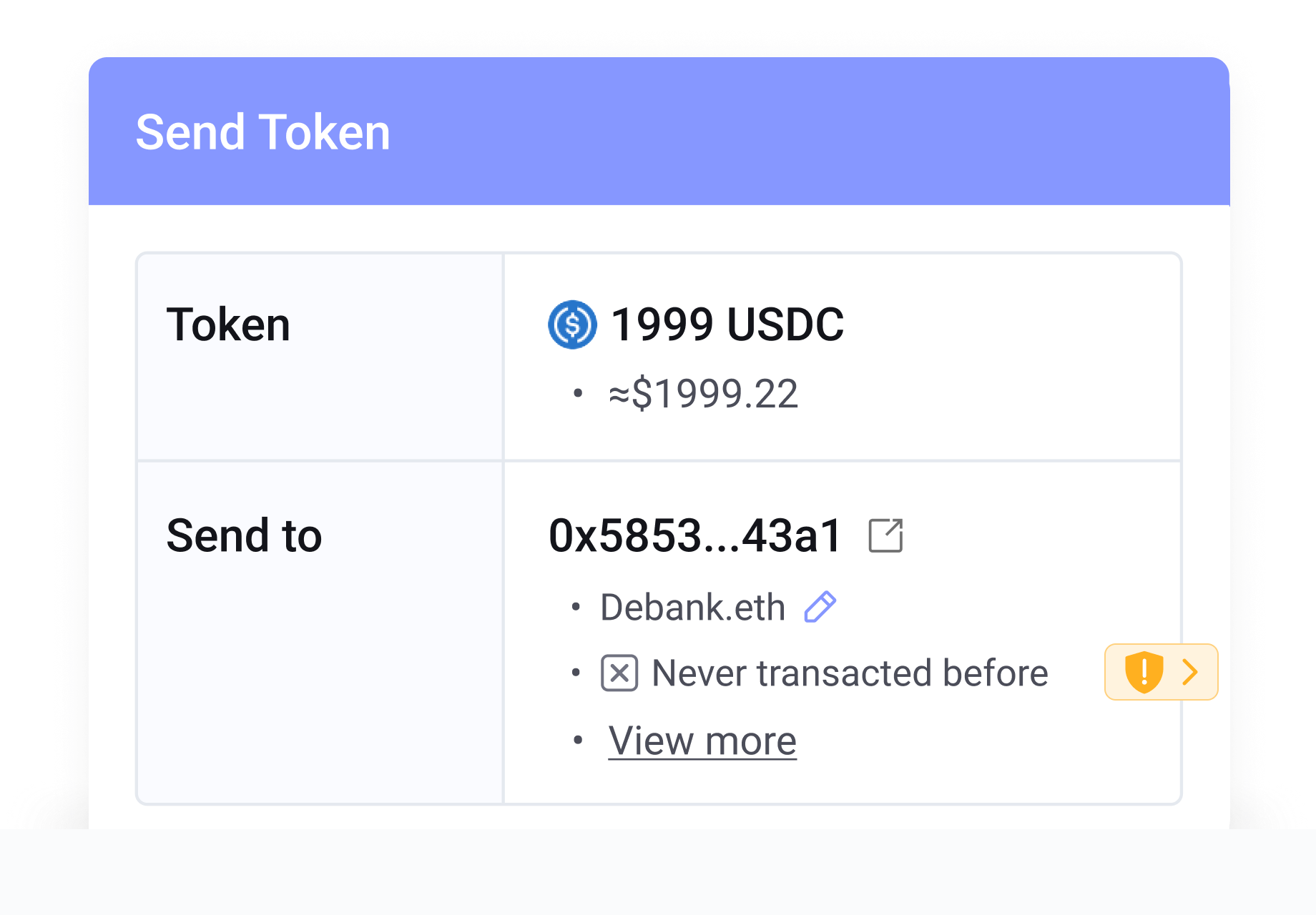
First, transaction simulation. Before a transaction is signed, Rabby runs a local simulation that estimates token flows and fee costs and displays the exact expected balance changes. Mechanism: the extension performs a dry‑run (a call to the node using the transaction data) to reconstruct how token contracts will respond and to compute gas spend. For users this turns abstract calldata into concrete numbers—what token you will lose, what token you’ll receive, and how much gas the network will charge—limiting blind-signing errors.
Second, pre-transaction risk scanning. Rabby integrates a security engine that cross-references the transaction target and call pattern against a database of known hacked contracts and suspicious approval patterns. The engine flags oddities (e.g., approvals granting infinite allowance, recipients that do not match common patterns) and surfaces warnings before you sign. The mechanism is pattern-detection plus a curated blacklist: not perfect, but effective at catching common pitfalls.
Third, approval management and multi-sig integration. Rabby exposes an approval revocation tool that enumerates active allowances and lets users revoke them directly from the extension. That lowers the window of exposure when interacting with unfamiliar contracts. For institutional workflows, Rabby plugs into multi-sig and custody systems (Gnosis Safe, Fireblocks, Amber, Cobo) so the same approval hygiene and simulations can intersect with enterprise controls.
Side-by-side mental model: Rabby extension versus mainstream alternatives
Think in three axes: safety tooling, usability friction, and integration breadth.
Safety tooling: Rabby scores high. Transaction simulation and pre-sign scanning convert unknowns into explicit, inspectable outputs. MetaMask, the dominant alternative, lacks a built-in transaction simulation UI by default; third-party tools can do similar checks, but that requires users to add steps. Rabby’s approach reduces human error by placing checks in the signing loop.
Usability friction: Rabby removes some friction (automatic network switching) but creates others (no fiat on-ramp, no native staking UI). For active DeFi traders this is acceptable—trading and contract interactions benefit from reduced blind-signing; for casual buy-and-hold users who want a one-stop fiat to stake experience, the lack of an in-wallet on-ramp is a downside.
Integration breadth: Rabby supports 90+ EVM chains and hardware wallets (Ledger, Trezor, Keystone, etc.), and runs on Chromium-based browsers, mobile, and desktop. That matches or exceeds many peers and is a practical advantage for multi-chain power users who routinely hop between L2s and sidechains.
Where Rabby improves outcomes — and where it still breaks
Better outcomes: For a trader executing complex composable trades—say, swapping across AMMs, bridging assets, or unwinding LP positions—the simulation reveals slippage, exact token deltas, and the gas profile before signature. That materially reduces costly mistakes like approving the wrong token, signing transactions that drain funds, or paying unexpected gas premiums. Approval revocation reduces tail risk: long-lived infinite allowances are a frequent avenue for theft, and having revocation built-in shortens the exposure window.
Boundary conditions and failure modes: simulation and scanning are not perfect detectors. Simulations depend on accurate node state and the same on-chain conditions the transaction will face; front-running, mempool reordering, or sudden contract state changes (e.g., a vulnerability exploited between simulation and block inclusion) can still cause losses. The security engine’s blacklist will not catch genuinely novel exploits or adversarially crafted attacks that look benign at the call-pattern level. Remember the 2022 Rabby Swap incident: a related contract exploit cost roughly $190,000; the team froze the contract and compensated users, but that episode illustrates the limits of preventative tooling—post-incident remediation still matters.
Practical heuristics for deciding whether to download the extension
Heuristic 1 — You should consider Rabby if you: (a) execute frequent DeFi transactions across multiple EVM chains, (b) need hardware wallet support inside a browser flow, or (c) operate under institutional multi‑sig requirements. The combination of simulation + approval revocation materially reduces operational risk in these workflows.
Heuristic 2 — Choose a different wallet when: you primarily want a fiat on‑ramp and a simple custodial custody experience, or you need native in-wallet staking and yield aggregation dashboards. Rabby explicitly lacks a built-in fiat purchase path and native staking UI; those gaps are design choices that favor security tooling over retail simplicity.
Heuristic 3 — Always layer protections. Even with Rabby, use hardware wallets for large balances, keep a narrow set of active approvals, and pair the extension with external monitoring and third-party contract review tools for large-value interactions.
Download, installation, and the US regulatory context
Rabby is distributed as a Chromium extension (Chrome, Brave, Edge), with mobile and desktop clients. Because it is non‑custodial and open-source (MIT license), it places operational responsibility on the user. In the US context this matters: non-custodial wallets reduce counterparty regulatory exposure but increase the user’s legal and operational obligation to secure private keys. Institutional users often couple the extension with custody providers like Fireblocks precisely to reconcile compliance and key-management requirements.
For a direct entry point to the extension and resources, see this official page on the wallet: rabby wallet. That link leads to downloads and documentation; verify you are installing the extension from an official source and not an impersonator—browser extension impostors are a common attack surface.
Decision-useful checklist before trusting any browser wallet
1) Verify distribution: only install from official vendor pages or verified store listings. 2) Use hardware wallet integration for significant balances. 3) Run small-value test transactions to confirm addresses and gas behavior. 4) Revoke unnecessary approvals frequently. 5) Keep the extension and your browser updated. These steps reduce the common vectors that even a well-architected wallet cannot eliminate.
FAQ
Is Rabby extension safer than MetaMask for complex DeFi transactions?
Safer in the sense that Rabby integrates transaction simulation and pre-sign checks directly into the signing path, reducing blind-signing. That lowers human error risk. But “safer” is conditional: both wallets can be used securely if combined with hardware wallets, careful approvals, and good operational practice. Rabby’s built-in tools simply make some risk-mitigation steps more frictionless.
Can Rabby buy crypto with USD inside the extension?
No. Rabby currently lacks an in-wallet fiat on‑ramp. Users in the US must buy crypto via exchanges or third-party on‑ramps and transfer assets to the wallet. That’s a trade-off: better security tooling in exchange for no direct fiat purchase convenience.
Does transaction simulation prevent front-running or MEV?
No. Simulation shows expected outcomes based on current chain state; it does not change how transactions are ordered in the mempool or prevent Miner/Maximal Extractable Value (MEV) strategies like sandwich attacks. It’s a diagnostic, not a transactional priority mechanism. To address MEV you need additional tooling (private transaction relays, gas management, or on-chain execution strategies).
Should institutions use Rabby directly?
Institutions often use Rabby alongside enterprise custody and multi-sig solutions. Rabby’s integrations with Gnosis Safe, Fireblocks, and similar platforms let teams combine Rabby’s UX and simulation benefits with institutional key-management, which is a sensible hybrid approach.
Final takeaway: for US-based DeFi power users who trade frequently, manage multi-chain positions, or operate within institutional workflows, Rabby’s extension is a pragmatic choice because it brings simulation and approval hygiene into the signing loop. Those mechanisms materially reduce routine operational risk, though they do not remove systemic risks like novel contract exploits, MEV, or phishing via malicious extensions. Treat the extension as a risk‑reduction tool, not a cure: combine it with hardware wallets, limited approvals, and regular auditing for a defensible posture in active DeFi operations.